Walk into any chemical processing plant that is more than five years old and look down. The steel grating under your feet — the stuff that supports operators, tools, and equipment over sumps, trenches, and chemical tanks — is rusting. The galvanizing wore through at the cross-bar welds two years ago. The base metal is pitting where sulfuric acid mist settles. The plant manager has a budget line for “grating replacement” that recurs every three to five years like clockwork. FRP grating breaks that cycle. Here is the engineering case for making the switch.
The Real Cost of Steel Grating in Corrosive Environments
A chemical plant spends surprisingly little on the grating itself — $40–80 per square meter for standard galvanized steel bar grating. The real costs hide in the installation, the downtime, and the collateral damage. To replace a section of corroded grating, the area must be cordoned off. Production above or adjacent to the area often stops — you cannot safely run a process while maintenance crews are removing grating over live chemical containment. Scaffolding goes up. The old grating is cut out (sparks near chemical tanks require a hot work permit and fire watch). The new grating is hoisted in, welded or clamped into place, and the area is re-opened. The total cost of a grating replacement — including labor, downtime, permits, and overhead — runs 3–5× the material cost of the grating itself.
Then there is the collateral damage. Rust particles falling from corroded grating into chemical baths below contaminate product and accelerate tank corrosion. Operators stepping over soft spots they don’t trust is a safety incident waiting to happen. The American Society of Safety Professionals reports that deteriorated walking-working surfaces are the second most common cause of industrial fall accidents, behind only unguarded edges. A single slip-and-fall injury costs an average of $45,000 in direct medical and workers’ compensation costs — enough to replace 500 square meters of grating.
Why Galvanized Steel Falls Short
Hot-dip galvanizing applies a zinc coating 65–85 microns thick to steel grating. In a neutral outdoor environment, this coating protects the steel for 30–50 years through sacrificial corrosion — the zinc corrodes instead of the steel. In a chemical plant environment, that timeline collapses. Acidic fumes (sulfuric, hydrochloric, nitric) dissolve the zinc coating at rates of 5–15 microns per year. Chloride exposure (from brine systems, coastal locations, or de-icing chemicals) accelerates the attack through pitting corrosion that penetrates the zinc layer at discrete points. Once the zinc is breached — which happens first at welded joints where the coating is thinnest — the underlying steel rusts at 50–100 microns per year.
Stainless steel grating (304 or 316L) solves the rust problem but at enormous cost — $200–400 per square meter, 3–5× the cost of galvanized steel. And even stainless is vulnerable to chloride stress corrosion cracking in the heat-affected zones around welds. A 316L grating in a chlor-alkali plant will develop cracks at the weld joints within 2–3 years, creating a different but equally dangerous failure mode.
How FRP Grating Solves the Core Problem
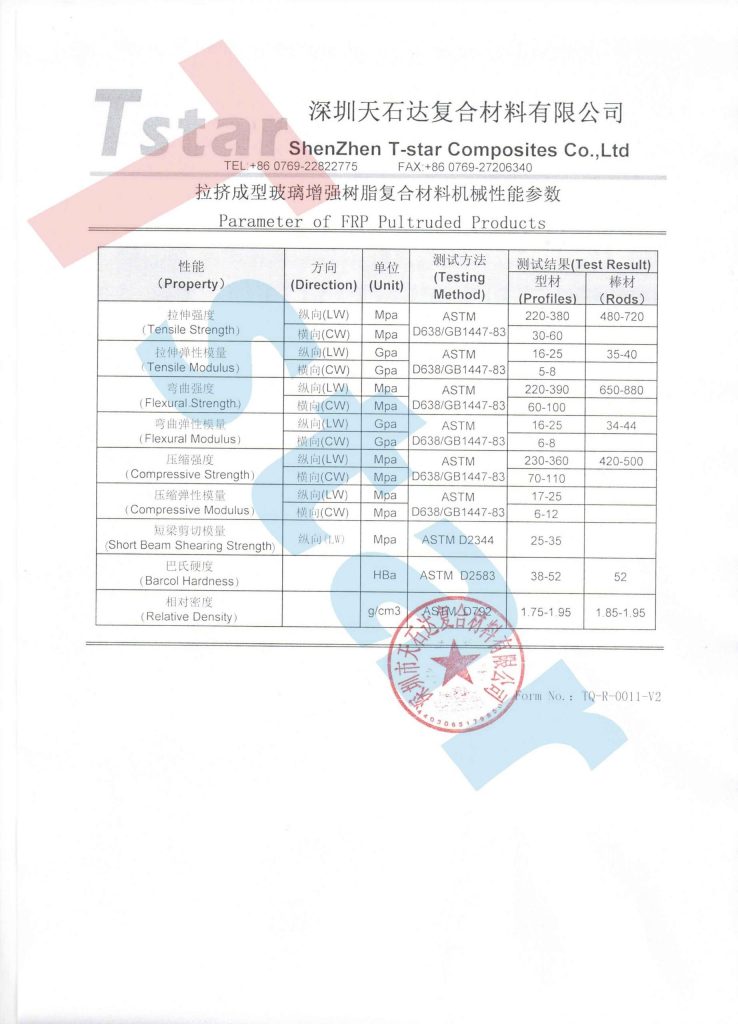
FRP grating is inherently corrosion-proof. The glass fiber reinforcement provides structural strength (flexural modulus 10–15 GPa). The resin matrix — typically isophthalic polyester for general chemical resistance or vinyl ester for severe acid/oxidizer service — encapsulates every fiber and provides a continuous, non-reactive surface. There is no coating to breach, no weld to preferentially corrode, and no metal to rust. ASTM C581 testing shows FRP laminates retaining over 95% of flexural strength after 12 months of continuous immersion in 30% sulfuric acid at 50°C — conditions far more aggressive than the atmospheric exposure that grating sees in service.
The weight advantage is the second benefit that pays off during installation. FRP grating weighs 12–20 kg/m² compared to 35–50 kg/m² for steel. Two workers can carry and position a 3-meter FRP grating panel without mechanical lifting equipment. The same panel in steel requires a hoist or four workers. Installation labor costs for FRP grating run 30–50% lower than steel simply because the panels are lighter and easier to handle.
Electrical non-conductivity is the third benefit. Steel grating in electrical areas — battery rooms, transformer vaults, electrolysis cell floors — must be electrically bonded and grounded. A loose cable contacting ungrounded steel grating creates an electrocution hazard. FRP grating is non-conductive (dielectric strength >10 kV/mm for a 6 mm section) and requires no bonding or grounding. This simplifies installation and eliminates an entire category of electrical safety risk.
Implementation: From Assessment to Deployment
Switching from steel to FRP grating starts with a chemical environment assessment. Identify the specific chemicals present (vapor and liquid), their concentrations, and the maximum temperature the grating will see. This drives resin selection: isophthalic polyester for general acid/alkali service to 65°C, vinyl ester for strong acids, oxidizing agents, and temperatures to 95°C, or phenolic for extreme fire resistance (ASTM E84 Class A flame spread).
Next, verify the load requirements. FRP grating spans are shorter than steel for the same load rating because the flexural modulus is lower. A typical FRP grating panel with 38 mm thickness spans 1.2–1.5 meters between supports at a 5 kN/m² uniform load rating. Steel grating of the same thickness spans 1.8–2.0 meters. If your existing support structure is on 1.8-meter centers, you either need thicker FRP panels (50 mm) or additional intermediate supports. Do not simply substitute FRP for steel without checking span tables — this is the most common cause of FRP grating failures in the field.
Installation is straightforward but different from steel. FRP grating cannot be welded — it uses bolted or interlocking clips at every support beam intersection. The clips must be stainless steel (316L minimum) to avoid creating a new corrosion source. Allow 6 mm of thermal expansion gap between panel edges — FRP expands roughly 3× more than steel with temperature changes, and restrained panels will buckle. All field cuts expose glass fibers and must be sealed with resin to prevent wicking (capillary absorption of liquid into the laminate). A field cut that is not sealed will delaminate within 6–12 months.
Measurable Results: What to Expect After Switching
Plants that have switched from steel to FRP grating in corrosive areas report consistent results. Grating service life extends from 3–5 years (galvanized steel) to 15–20 years (FRP). Maintenance spending on grating drops 70–80% because the primary failure mode — corrosion — is eliminated. Installation-related downtime falls by roughly half because FRP panels are lighter and can be cut to size on-site with standard carbide-tipped tools (no hot work permit required).
Safety incident rates related to deteriorated walking surfaces drop to near zero — there is no rust to create soft spots, and FRP grating is manufactured with a gritted top surface that maintains a coefficient of friction above 0.8 even when wet with oil or chemicals. The payback period for the higher upfront cost of FRP grating ($80–150/m² vs $40–80/m² for galvanized steel) is typically 2–4 years when installation labor, downtime, and maintenance savings are included. Over a 20-year lifecycle, FRP grating costs 50–60% less than galvanized steel in corrosive service.
FRP vs Steel vs Stainless Steel Grating Comparison
| Property | FRP Grating (Polyester) | FRP Grating (Vinyl Ester) | Galvanized Steel | Stainless 316L |
|---|---|---|---|---|
| Weight (kg/m², 38mm) | 14–18 | 14–18 | 38–45 | 38–45 |
| Span at 5 kN/m² (m) | 1.2–1.5 | 1.2–1.5 | 1.8–2.0 | 1.8–2.0 |
| Corrosion Resistance | Excellent (general chem) | Excellent (strong acids/oxidizers) | Poor (coating dependent) | Good (except Cl⁻ SCC) |
| Service Life (chemical plant) | 15–20 years | 18–25 years | 3–5 years | 8–12 years |
| Electrical Conductivity | Zero (non-conductive) | Zero (non-conductive) | Conductive | Conductive |
| Slip Resistance (wet) | 0.8–0.9 CoF | 0.8–0.9 CoF | 0.5–0.6 CoF | 0.5–0.6 CoF |
| Installation Method | Clips/bolts (no hot work) | Clips/bolts (no hot work) | Weld or clamp | Weld or clamp |
| Material Cost (/m²) | $80–120 | $120–180 | $40–80 | $200–400 |
| 20-Year Lifecycle Cost | Lowest | Low | Highest (replace 4–6×) | High (replace 1–2×) |
FRP TSTAR supplies molded and pultruded FRP grating for chemical processing, water treatment, offshore, and industrial applications. Standard and custom panel sizes with isophthalic polyester, vinyl ester, or phenolic resin systems. Engineering support for span calculations, resin selection, and installation planning. Contact us with your chemical environment data for a material recommendation and quotation.